
Padel guide
Padel rules
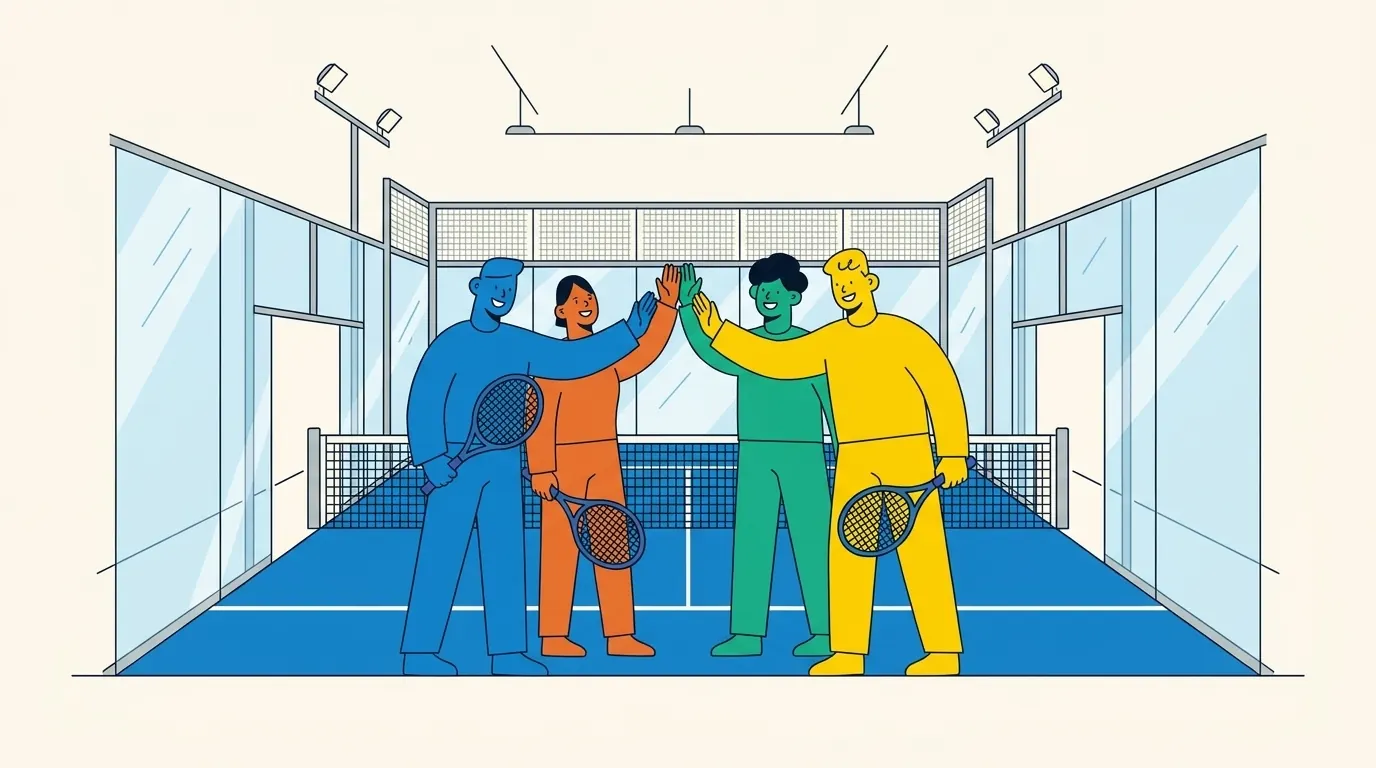
The padel rules fit on one page. Serve underarm, one bounce, then the walls count. Scoring works like tennis.
- Serve
- underarm, diagonal
- Attempts
- 2
- Scoring
- 15 · 30 · 40
- Set
- 6 games
01
The court and its walls
The court is 20 × 10 metres and fully enclosed. Glass and mesh are part of the game, but only on your own side and only after the bounce.
The service line sits 6.95 metres from the net. The centre line splits the space between them into two service boxes.
02
The serve
Bounce the ball behind the service line and hit it at or below waist height. At least one foot stays on the ground, behind the line.
The ball must land diagonally in the opposite service box. If it then hits the glass, that is fine. If it hits the mesh first after the bounce, it is a fault. You get two attempts.
03
The rally
The receiver must let the serve bounce. After that any ball may be volleyed or played after one bounce.
After the bounce the ball may come off the walls on your side as often as it likes before you play it. You may also hit it into your own wall so it goes over the net.
04
What the walls allow
Your shot must land in the opponents’ court before it touches a wall. Hit their wall or mesh directly and you lose the point.
If a ball bounces and then leaves the court over the wall, it may be played outside where the venue has exits. That is the “por tres” or “por cuatro”.
05
Scoring
Scoring is as in tennis: 15, 30, 40, game. A set goes to six games with a two-game lead, with a tiebreak at 6–6. Matches are usually best of three sets.
At 40–40 the classic rule is advantage. Many tournaments and nearly all social games use golden point: one point decides the game, and the receiving team picks the side.
06
When you lose a point
The ball bounces twice on your side. You hit it into the net, out, or straight into the opponents’ wall.
The ball hits you or your partner. You touch the net with your body or racket, or you hit the ball twice in a row.
Americano or Mexicano with your group?
The free generator makes the schedule and keeps the table. No sign-up.
Frequently asked questions
Can you volley the serve?
No. The serve must bounce first. After that, volleys are allowed.
What is golden point?
At 40–40 a single point decides the game instead of playing advantage. The receiving team chooses which side the serve goes to.
Can the serve hit the wall?
Yes, the glass after bouncing in the right box. If it hits the mesh first after the bounce, the serve is a fault.
Can you play the ball off your own wall?
Yes. You may hit the ball into a wall on your side, as long as it then goes over the net into the opponents’ court.
Updated 15 November 2026
Read next
- Padel guideWhat is padel?What is padel? The court, rackets, ball, the rules in brief, where it comes from and why it is so easy to learn — explained simply.Read →
- Padel guidePadel tournament formatsAmericano, Mexicano, Team Americano, King of the Court, round robin and knockout: every padel tournament format compared, with recommendations.Read →
- Tournament formatPadel AmericanoPadel Americano explained: how pairings rotate, how points are counted, how many rounds you need — with a sample schedule and a free generator.Read →
- Tournament formatPadel MexicanoPadel Mexicano explained: how pairings come from the standings, how it is scored and when Mexicano is fairer than Americano.Read →
- Free · no sign-upAmericano generatorEnter names, choose courts, start playing. The generator makes a fair schedule for Americano or Mexicano and keeps the table.Read →